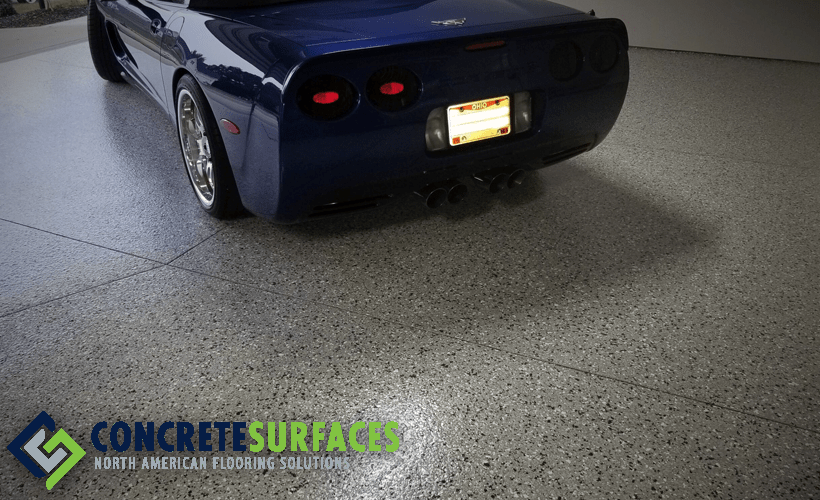
Ohio winters are hard on garage floors. Road salt, freeze-thaw cycles, and damp basements push moisture through bare concrete. Hot tires drop oil. Snow boots track grit across every surface. The right epoxy coatings for garage floors fix these problems. They turn a worn slab into a clean surface built to last for decades. Many homeowners confuse latex paint with a true epoxy floor coatings, but the two products perform very differently under garage use. American Concrete Surfaces has installed thousands of new garage floors across Cambridge, Zanesville, and surrounding Ohio areas for 25 years. This guide gives you five practical tips for choosing the best epoxy and getting long-term performance from your new garage floor.
Why Ohio Garages Need Specialized Coatings
Ohio is a tough zone for concrete floors. Summer humidity pushes moisture vapor up through the slab. Winter brings rock salt, calcium chloride, and brine that eat through cheap finishes. Temperatures swing from January cold snaps to July heat waves, and the concrete expands and contracts with every shift. A DIY garage kit from home improvement stores cannot handle this stress. If your garage floor is stained or peeling, a weekend product is not the answer.
Professional-grade floor systems use stronger resins, deeper prep work, and protective topcoats that act as a sealer. They chemically bond to concrete instead of sitting on top like floor paint. The result is a floor coating that resists hot tire pickup, salt corrosion, oil spills, and impact damage for 15 to 20 years.
Garage Floor Paint vs. True Epoxy: Two Main Options
Walk into any home improvement store and you will see two main options for garage floors. Concrete floor paint is basically latex paint with a few light additives. It rolls on like wall paint, dries in hours, and starts wearing off in months. Vehicle traffic, hot tires, and oil spills strip garage floor paint quickly.
A real epoxy floor coating works in a different way. Epoxy is a two-part resin system. You mix Part A (epoxy resin) with Part B (hardener), and a chemical reaction creates a hard, plastic-like surface. True epoxy bonds with the concrete at a molecular level. Solids epoxy (100% solids) creates the thickest, strongest layer. Water-based epoxy is thinner and easier for DIY garage projects, but it offers less protection. For real garage use, only a two-part epoxy or a polyaspartic system gives you the durability you need.

Three Coating Types That Work in Ohio
Three resin systems perform well in our region. Each one has a clear best use among garage floor application options.
- Polyaspartic and polyurea coatings cure in hours, resist UV damage, and shrug off road salt. Professional-grade polyaspartic handles hot tires without softening. This is the top pick for daily-driver garages.
- Epoxy flake and chip systems combine a base coat with broadcast decorative vinyl flakes and a clear sealer topcoat. They hide concrete flaws and add slip resistance, which makes them ideal for residential garages.
- Metallic epoxy creates a swirled, three-dimensional showroom finish. It works best in display garages where appearance matters more than tire abuse.
Tip 1: Test for Moisture Before You Coat
Ohio basements and slab-on-grade garages share the same enemy: rising moisture vapor. Water pushes up through porous concrete pores even when the surface looks dry. Skip moisture testing, and the epoxy will fail through delamination, bubbles, or peeling.
Before applying epoxy, run a calcium chloride test or use a relative humidity probe. These tools measure how much moisture the slab releases. If the readings are high, a moisture vapor barrier primer adds a sealed layer between the concrete and the coating. American Concrete Surfaces tests every floor before installation begins.
Tip 2: Pick Polyaspartic Topcoats for Salt and UV Resistance
Standard traditional epoxy works fine as a base coat. The problem starts when that same epoxy serves as the final wear layer. Epoxy yellows in sunlight, softens under hot tires, and slowly degrades from salt exposure.
A polyaspartic topcoat fixes all three weak spots. Polyaspartic is a fast-curing aliphatic polyurea. It cures clear, stays clear, and forms a hard sealer against scratches and chemicals. Key benefits include:
- UV stability that prevents yellowing
- Salt resistance against winter brine
- Chemical resistance to gasoline and antifreeze
- Fast cure with return-to-service in 24 hours
- Hot tire pickup resistance for summer heat
A hybrid floor system pairs an epoxy base coat with a polyaspartic topcoat. You get deep penetration into the concrete plus a UV-stable wear surface.
Tip 3: Use a Full-Broadcast Flake System for Daily-Use Garages
Solid color coatings show every speck of dirt, every footprint, and every drip of mud. Flake systems hide all of that. A full-broadcast flake system uses colored decorative vinyl chips. Installers scatter them across the wet base coat until the entire floor is covered. A clear polyaspartic topcoat locks them in place.
The result is a textured, multi-tone surface that masks flaws in the original concrete. Small cracks and color shifts disappear under the flakes. The chip texture grips wet boots, so slip resistance improves. Cleanup stays easy because the topcoat is non-porous. This is the choice for homeowners who want a long-lasting garage floor coating that handles real life and stands up to the demands of a garage.
Tip 4: Demand Proper Surface Preparation
This step separates real pros from quick-flip operators. Acid etching is not enough for a long-lasting bond. Acid eats the surface, raises a soft layer, and leaves residue behind. Coatings designed to chemically bond to concrete cannot grip etched surfaces well, and a weak bond to your concrete leads to early peeling.
Real prep work needs diamond grinding with industrial equipment. The grinder removes contaminants, opens the bare concrete, and creates a surface profile (CSP-3 or CSP-4) that the epoxy resin can grip. Cracks get filled with polyurea repair. Pitted areas get patched. The floor is then vacuumed clean.
A proper prep job takes time:
- Diamond grinding the entire floor
- Repairing cracks with flexible polyurea
- Patching spalls, pits, and divots
- Vacuuming every gram of dust before priming
American Concrete Surfaces uses commercial grinders and HEPA vacuums on every project. We deliver the bond strength the resin manufacturer specifies.
Tip 5: Hire a Local Pro With Real Experience
DIY kits, floor mats, garage floor tiles, and other floor coverings cost less upfront. They also fail under daily use. Tiles shift, mats trap dirt, and neither delivers the seamless look of a poured floor system. Real coatings designed specifically for garage applications cost more because they include premium materials, stronger prep, and longer warranties.
- DIY Kits: $0.50 to $2.00 per square foot
- Professional Epoxy: $3.00 to $5.00 per square foot
- Professional Polyaspartic: $4.00 to $7.00 per square foot
A local installer brings advantages a national chain cannot match. They know your slab conditions and how Ohio winters affect cure times. Look for these signs of quality before you choose the right garage floor coating partner:
- Verifiable insurance and worker’s compensation
- Manufacturer training certifications
- A portfolio of local jobs you can visit
- Written warranties of 10 years or longer
American Concrete Surfaces brings 25 years of experience to every project. Our crews work across Cambridge, Coshocton, Dover, Cadiz, Marietta, Newark, Canton, Zanesville, and New Philadelphia.
Common Questions Ohio Homeowners Ask
How long does the best garage floor coating last in Ohio?
A professionally installed polyaspartic-topped system lasts 15 to 20 years with normal residential use.
Can garage floor epoxy be installed in winter?
Yes, with the right product. Polyaspartic coatings cure at temperatures as low as 0°F. Standard garage floor epoxy needs the slab above 50°F.
Will the coating crack if my concrete cracks?
Hairline cracks get filled before coating. Flexible polyurea repair lets the coating bridge minor movement.
Ready to Transform Your Garage?
A professional home improvement upgrade turns the dirtiest room in your house into a clean, durable space you can finally use your garage for again. The right epoxy coatings for garage floors handle Ohio winters, summer heat, and everyday wear without complaint. American Concrete Surfaces has spent 25 years perfecting garage coatings for residential garages across Cambridge and surrounding counties.

Call us today at 1-888-618-0902 for a free estimate, please visit our job photo gallery of past flooring installations we have completed. Your perfect new garage floor is just one phone call away.

Jason has over 25 years of experience being a professional epoxy contractor providing customers with custom floor coating installations in Ohio to fit any need or budget. Referrals are our best friend and customer satisfaction is always our top priority. When Jason is not working you can find him hunting across America.




Share This Article
Choose Your Platform: Facebook Twitter Google Plus Linkedin